15 Fascinating Facts About Heaton & the Ouseburn
Fifteen genuinely surprising stories from east Newcastle, from a medieval king's well and a shoe-covered tree to Britain's biggest pottery and a bust that sits on Karl Marx's grave.
East Newcastle packs an astonishing amount of history into a small patch of ground. Walk from the Tyneside flats of Heaton down into the Ouseburn valley and you cross a medieval manor, the cradle of the city's industry, and one of Britain's most celebrated pieces of post-war architecture. Here are fifteen genuinely fascinating, verifiable facts about Heaton and the Ouseburn.
Best for:
Want the full sweep of the area's story? See our history of Heaton, Ouseburn and Byker for the complete timeline, from medieval manor to modern cultural quarter.
1. The name literally means "high town." Heaton comes from the Old English for "high town", a nod to its position on the hills above the Ouseburn, a tributary of the Tyne, about two miles east of Newcastle city centre. The valley below did the industrial heavy lifting; the town looked down on it from above.
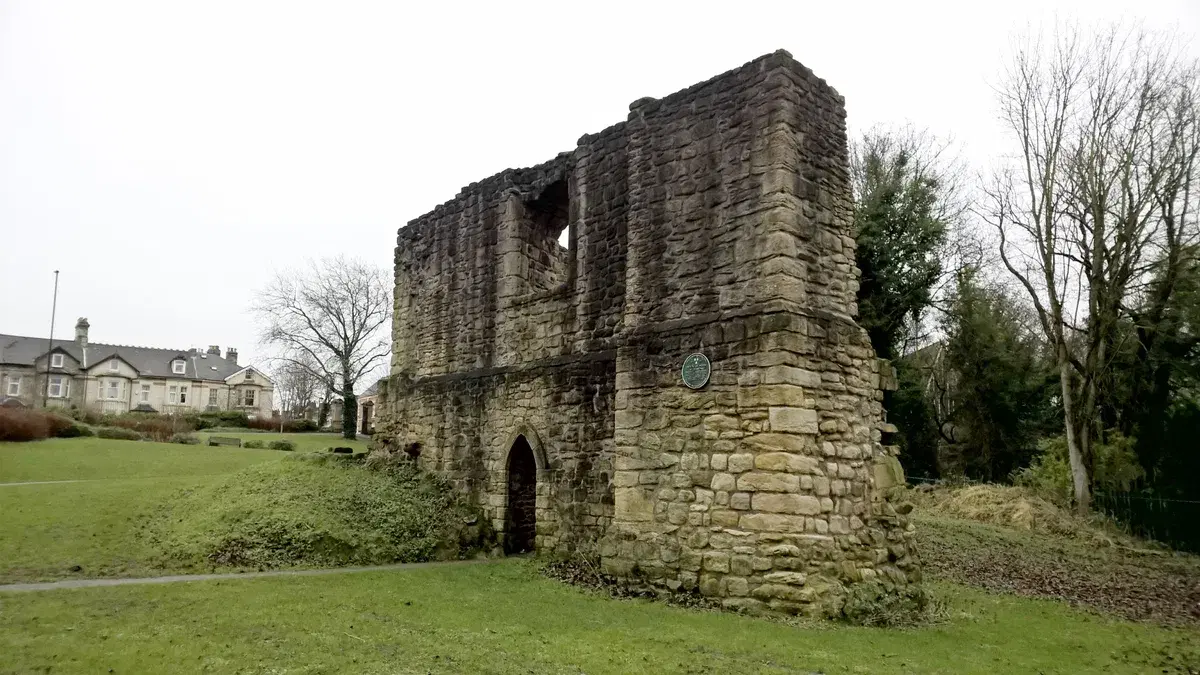
2. There is a genuine medieval ruin hidden in a public park. The remains of King John's Palace still stand in Heaton Park. Properly called Adam of Jesmond's Camera, it was a fortified 13th-century manor house incorporating an earlier 12th-century tower. It is Grade II listed, and tradition holds that King John himself stayed here.
3. Nearby there is a "well" named after the same king. Just over in adjoining Armstrong Park lies King John's Well, thought to have been a medicinal spring serving the palace. A photograph from 1888 records a stone lintel inscribed "YE WELL OF KING JOHN" set into a rockery above the water trough.
4. A tree in Armstrong Park is covered in shoes. The famous Shoe Tree is a sycamore in Armstrong Park hung with pairs of footwear knotted together by their laces. The student tradition goes that leavers throw up a pair of shoes as a testimonial to the city. In 2020 the Woodland Trust shortlisted it for its English Tree of the Year.
5. The Ouseburn was the cradle of Newcastle's industry. Long before it became the city's cultural quarter, the Lower Ouseburn was its workshop. From the 17th century onwards the narrow valley filled with potteries, flint mills, glassworks, lead works, iron foundries and flour mills, all crowded together where the burn meets the Tyne.
6. It was once home to Britain's biggest pottery. Maling, which moved to the Ouseburn area from Sunderland in 1817, grew into the largest pottery on Tyneside. Its final Ford works occupied a fourteen-acre site that the firm claimed was the biggest pottery in Britain. Over two centuries Maling produced more than 16,500 different patterns before closing in 1963.
7. A famous music venue is a converted flax mill. The building at 36 Lime Street, now home to The Cluny bar and live-music venue, was built as a flax mill in 1848 to a design by the great Newcastle architect John Dobson. It later became a flour mill, and in the 1920s stored bonded whisky under the "Cluny" brand, which is where the venue's name comes from.
8. One of the world's early laminated-timber viaducts crossed the valley. The Ouseburn Viaduct opened in 1839 for the Newcastle and North Shields Railway, ten years before Stephenson's High Level Bridge. Its original arches were built from glued laminated timber, an early use of the technique now called glulam, before being replaced with near-identical wrought-iron spans in 1869.
9. The river disappears underground before reaching the Tyne. The upper Ouseburn is carried through a culvert, vanishing beneath the city before re-emerging in the valley to flow under the viaducts and out to the river. What looks like open countryside above is threaded with buried watercourse.
10. A coal tunnel beneath the valley sheltered families from the Blitz. The Victoria Tunnel was cut between 1839 and 1842 as an underground waggonway carrying coal from the Town Moor down to the Tyne. When the colliery closed the tunnel lay abandoned, until the Second World War, when the city fitted it with bunks, lighting and blast walls and turned it into a communal air-raid shelter. A 700-metre section is open for tours today.
11. Landowners forced the railway to hide from Heaton Hall. Heaton Hall was built around 1713 by Richard Ridley, and the Ridley family stayed until about 1840. When the railway came, the Ridleys insisted the line be sunk out of sight where it crossed their land in front of the hall. The hall itself was demolished in the 1930s.
12. Three parks were gifted to the city as a single green corridor. In 1878–79 Newcastle Corporation acquired part of the Heaton Hall estate for Heaton Park, while the industrialist Lord Armstrong gave the city Armstrong Park and Jesmond Dene. The three run into one another, forming a continuous wooded corridor down the Ouseburn valley.
13. A Heaton writer's face sits on Karl Marx's grave. The author Jack Common was born in 1903 at 44 Third Avenue in Heaton and attended Chillingham Road School. Best known for his memoir Kiddar's Luck, he had another curious legacy: sculptor Laurence Bradshaw used his likeness for the bronze bust on Karl Marx's tomb in Highgate Cemetery, London.
14. Byker's celebrated "Wall" was built to block a road that never came. The Byker Wall is an unbroken block of 620 maisonettes designed by architect Ralph Erskine and built between 1969 and 1982. Its high, undulating form was meant to shield the low-rise homes behind it from a planned motorway, which was never built. Historic England gave the estate a Grade II* listing in 2007.
15. The valley now throws one of the city's best community festivals. Every summer the Ouseburn Festival takes over the valley's venues, spaces and independent businesses, the same restored Victorian warehouses that once served the potteries and mills. Many of those buildings now house cultural landmarks like Seven Stories and The Biscuit Factory, the UK's largest independent contemporary art, craft and design gallery.
Never miss what’s on
Join the weekly Heaton.live digest — the best events, news and local tips, straight to your inbox. Free, one email a week.
What's On
Comedy Course Showcase: New Student Showcase 2
7:30 PM · The Cumberland Arms, James Place Street, Ouseburn, Newcastle upon Tyne, NE6 1LD
La Chimera
7:30 PM · Star and Shadow Cinema, Warwick Street, Newcastle upon Tyne, NE2 1BB
Fresh Thursday: Deradoorian + Silver Ley + Mason Lindahl
7:00 PM · Cobalt Studios, 10-16 Boyd Street, Ouseburn, Newcastle upon Tyne, NE2 1AP