The History of Heaton's High Street
How Chillingham Road and Heaton Road grew from Victorian speculation into one of Newcastle's liveliest independent high streets. A history of shopping in Heaton.
Heaton is one of Newcastle's great high-street suburbs, a place where daily life still revolves around two busy shopping streets rather than an out-of-town retail park. That character is no accident: it was built in from the beginning. Here is the story of how Heaton's high streets came to be, and how they have changed.
A Victorian suburb
Heaton as we know it is largely a creation of the late 19th century. As Newcastle boomed on coal, engineering and shipbuilding, the city spread eastwards, and the fields of the old Heaton estate were rapidly covered with the distinctive Tyneside flats and terraces that still define the area. To serve this new population, two main streets were laid out with shops along their length: Heaton Road and Chillingham Road. From the outset, this was a suburb designed for high-street shopping.
The Co-operative and the corner shop
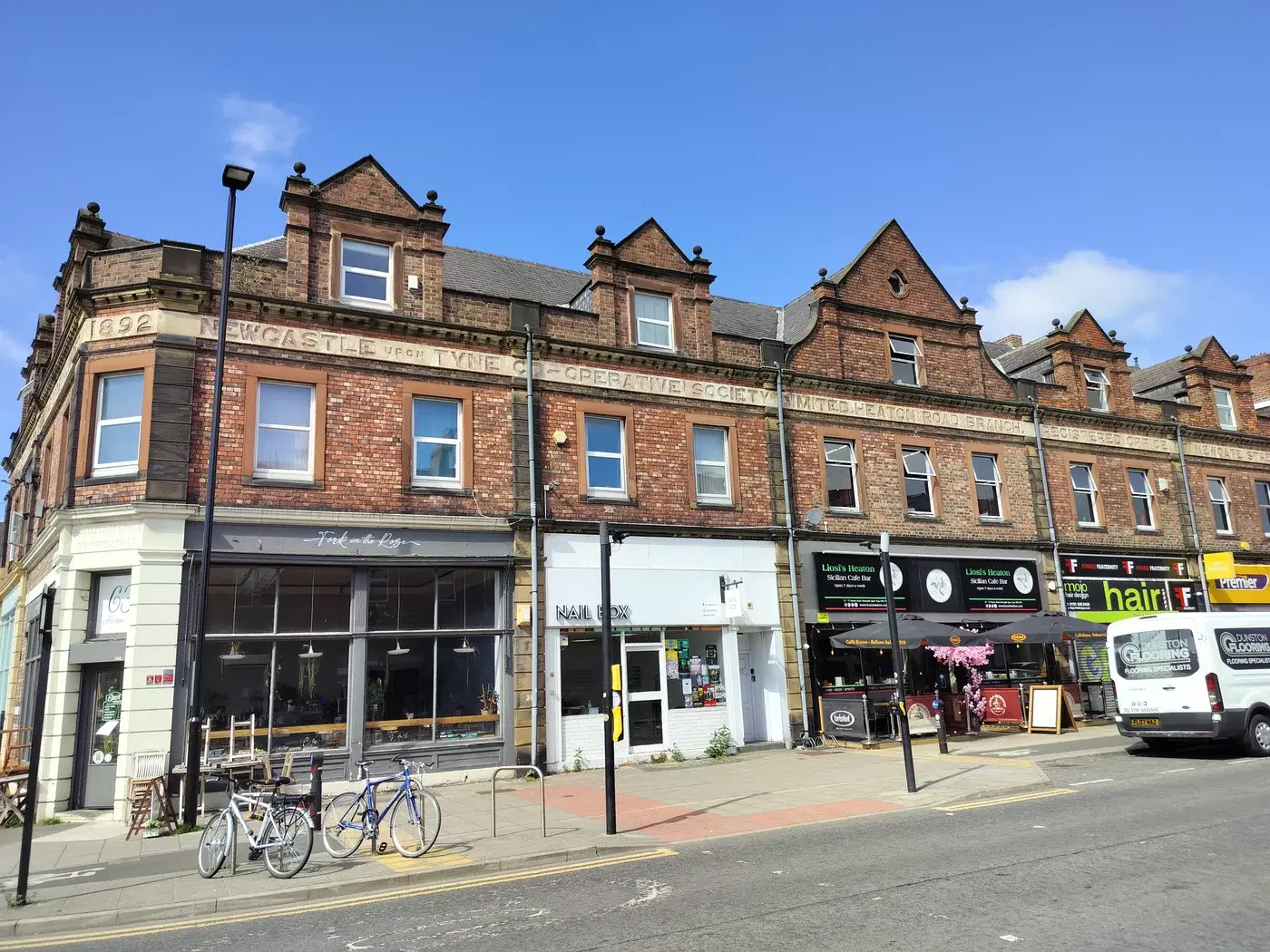
Central to working-class Heaton was the Co-operative Society. The grand former Co-op store on the corner of Heaton Road and Cardigan Terrace, pictured above, dates from 1892 and still stands three storeys high, a proud reminder of how important the movement was to ordinary families, who shopped there and drew their "divi". Around it clustered the butchers, bakers, grocers and drapers that made each stretch of street a self-contained centre.
The age of the picture palace
By the early 20th century the high street offered entertainment as well as provisions. Chillingham Road had its own grand cinema, the Scala Electric Theatre, which opened in 1913 with 1,200 seats and marble staircases. For half a century a night at the pictures was part of Heaton life, until the Scala closed in 1961 and was replaced, as so many were, by a supermarket.
Reinvention
Like every British high street, Heaton's has had to reinvent itself as shopping habits changed. The traditional trades have thinned, but rather than fading, Chillingham Road and Heaton Road have found new life as one of Newcastle's liveliest independent quarters, packed with cafes, bakeries, bars, a Michelin-listed restaurant and a run of charity and specialist shops. The arrival of the Metro at Chillingham Road helped keep the street busy and connected.
The high street today
What is striking is the continuity. More than a century on, Heaton still does its living on Chillingham Road and Heaton Road, still supports a dense mix of independents, and still treats its high streets as the centre of the community. For more, see our guides to eating on Chillingham Road and the lost buildings of Heaton.
Have memories or old photographs of Heaton's shops? Get in touch.
Never miss what’s on
Join the weekly Heaton.live digest — the best events, news and local tips, straight to your inbox. Free, one email a week.
What's On
Let 'Em Speak, FLINTA Comedy Open Mic
7:30pm · The Cumberland Arms, James Place Street, Ouseburn, NE6 1LD
King No-One
7:30 PM · The Cluny, 36 Lime Street, Ouseburn, Newcastle upon Tyne, NE1 2PQ
L.A.D.S: Ladies Open Decks and Social
5:30 PM · Cobalt Studios, 10-16 Boyd Street, Ouseburn, Newcastle upon Tyne NE2 1AP